The Last Echo began with a tension we kept noticing in games we enjoyed. Role-playing games are rewarding because a collection of small decisions gradually becomes a character and a strategy. Idle games are welcoming because progress does not demand uninterrupted attention. Yet combining the two often removes the strongest part of one side: either the game asks for constant maintenance, or it automates so much that the player becomes a spectator.
Our design question became: which actions are meaningful enough to keep, and which are repetition that software should handle?
Automate execution, preserve judgment
Repeating a battle that a party already solves consistently is execution. Choosing the equipment, abilities, and upgrades that make the battle solvable is judgment. The game can perform the first task while you are away without taking ownership of the second.
This distinction shaped offline progress. Returning should feel like coming back to the consequences of a prepared build, not receiving an unrelated daily gift. The collected rewards create options, and the next active session is where those options become decisions.
Make systems readable
Complexity is not the same as depth. A deep system creates consequences that players can learn; an opaque system hides the connection between action and outcome. Our interface aims to show the information needed at the point of choice: equipment comparisons near equipment, pity and probabilities near summons, and progression results when returning from time away.
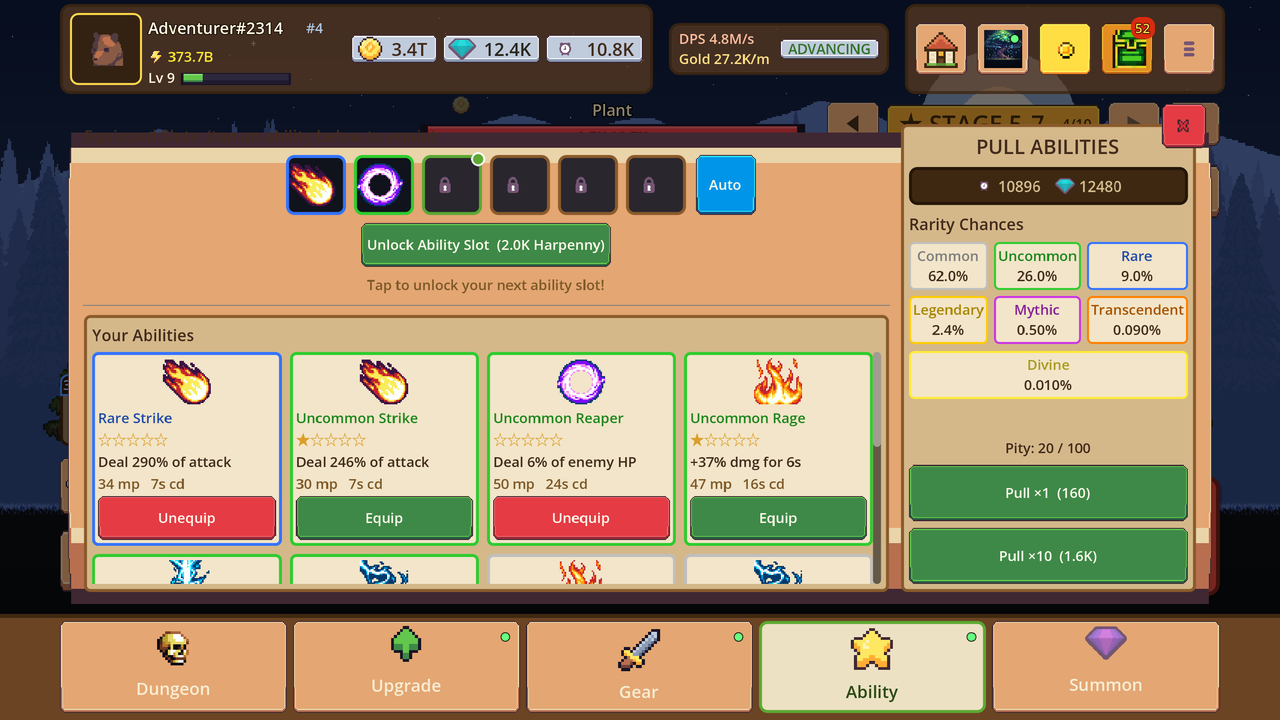
Readability also affects visual style. The paper, wood, and pixel-art presentation gives the world a warm, handmade character, but decoration should not overpower controls or text. We use familiar placement, strong contrast, explicit labels, and reduced-motion support on the website. The game continues to be tested for the same balance between character and clarity.
Fairness has to be implemented
“Fair” cannot live only in marketing copy. Random rewards are an area where presentation, mathematics, and monetization meet, so the rules must be concrete: published odds must match implementation, hard pity must be visible, premium currency must be earnable, and core completion must remain available without payment.
Those rules constrain design in useful ways. They force us to build progression that remains interesting without requiring a purchase and to earn trust through information rather than pressure.
Why a small team matters
The Last Echo is hand-built by a two-person indie team. That limits how quickly we can expand the game, but it also keeps the distance between feedback and implementation short. The person reading a support report is close to the code and design decision that produced the issue.
We would rather document a smaller set of working systems honestly than publish a long list of speculative features. The current website therefore describes the current App Store build separately from future platform availability and marks the Google Play release as coming soon.
What we are learning from the game
Testing is not only a search for crashes. It helps us find unclear screens, pacing that asks for too much attention, upgrades whose consequences are hard to read, and promises that the implementation does not communicate well enough. A useful report tells us what you expected, what happened, and where the mismatch appeared.
That is also why this development log and the player guides exist. They make our reasoning visible, give players a stable reference, and create a record we can update as the game changes. A game that respects time should also respect the time required to understand it.
Read next: how idle progression works · our fair-gacha rules · systems reference